
Grove City, OH · Garage Door Service
Garage Door Roller Replacement Around Grove City
Grove City area homes built 1938-2006 wear out rollers faster under severe cold. Here's why rollers fail, what it costs you if you ignore it, and when to swap them yourself.
- Repairs & new doors
- Springs & openers
- Serving 5 nearby communities
What Causes It Around Here
Most of the housing stock across this service area went up between 1938 and 2006, with the median build year landing around 1976. That matters for rollers because a mid-70s door was almost always hung with steel rollers on steel track, no nylon, no sealed bearing. Forty-plus years of use on that hardware means the roller stems wear oval instead of round, and the wheel itself flat-spots. You hear it before you see it - a grinding or knocking that gets louder as the door moves through the bend where the vertical track meets the horizontal.
The climate here does its own damage. This is a cold, severe-winter zone, and steel rollers don't like the swing between a dry sub-freezing night and a 40-degree afternoon. The metal contracts and expands, grit and road salt tracked in from the driveway work into the roller shaft, and the thin factory grease gums up or washes out. Nylon rollers handle that cycling better, but a lot of the original-equipment doors on 1960s and 70s builds across these neighborhoods still have the steel ones nobody thought to upgrade.
A door that's fine in July and starts grinding in January isn't a coincidence. That's the cold finding the weak roller it couldn't find in warmer months.
Where This Job Goes Sideways
Roller replacement looks simple and mostly is, until the track is bent. On older steel track - common on houses from the 1960s and 70s stock across this area - a worn roller has usually been hammering the same spot in the curve for a year or more before anyone calls. Swap the roller without checking the track radius there and the new roller binds in the same spot within weeks.
The other place it goes wrong is the bottom bracket. That bracket holds the end of a wound cable under real tension, and on a two-car door with a torsion spring system, pulling the wrong roller loose is how a cable comes off the drum. We don't pull bottom-fixture rollers with the door under spring tension - that's not a shortcut, that's how someone gets hurt.
Last thing: if a steel roller has been grinding long enough to wear a groove into the track itself, you're not replacing a roller, you're replacing a section of track. On a house with the original 1976-era track, that's worth knowing before you start, not after.
Doing It Yourself
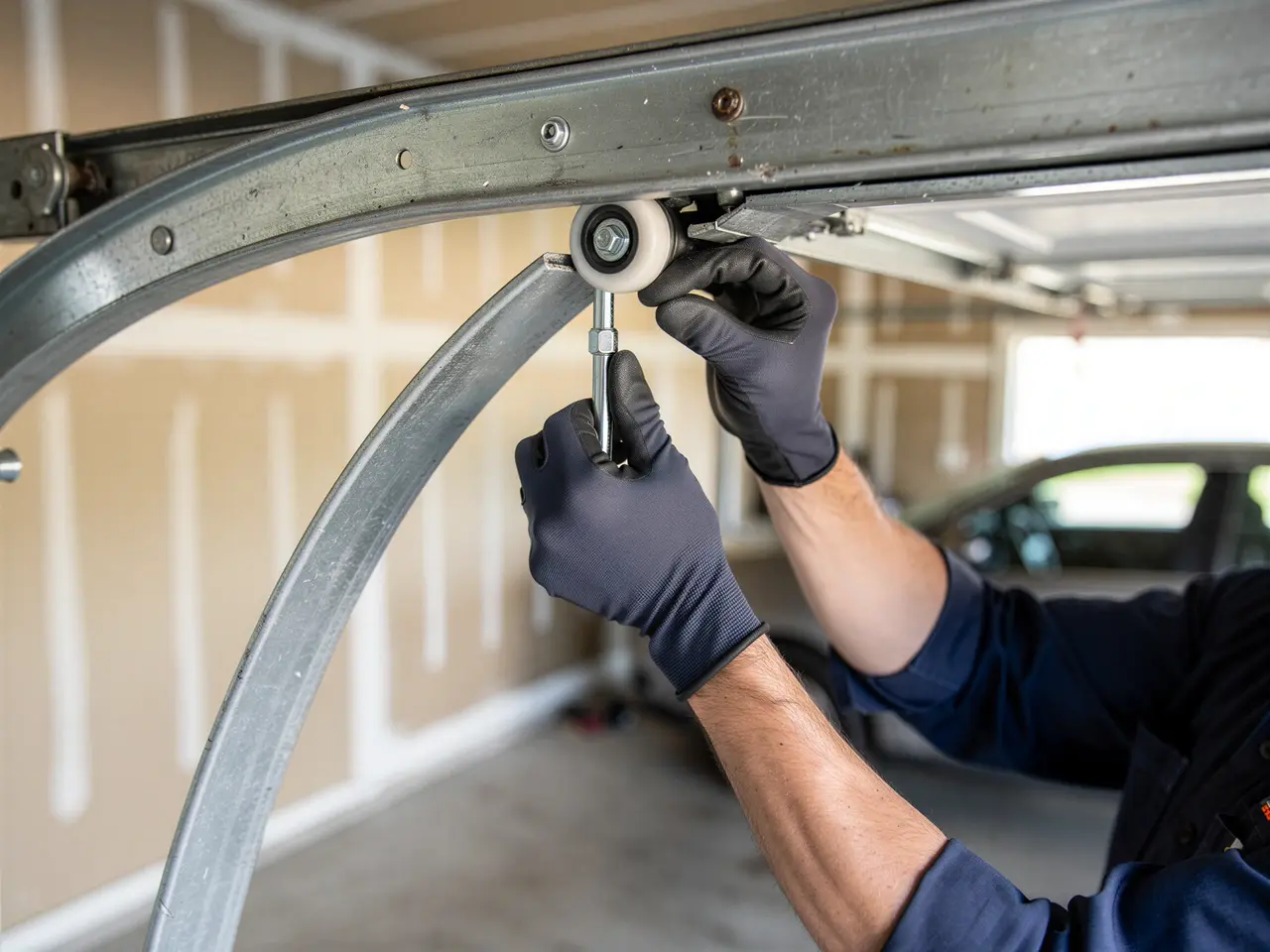
A top-section roller on a door that's down and unplugged is a reasonable weekend job if you've got vice grips to clamp the track and know which way the roller stem pulls free. Nylon replacement rollers with sealed bearings cost little and outlast steel ones in this climate by a wide margin - that part we'd tell anyone to do themselves.
Where we'd stop you: any roller tied into the bottom bracket on a door under spring tension, and anything on a door where the track itself looks gouged or the door no longer sits square in the opening. Those aren't roller jobs anymore, they're alignment or track jobs, and getting them wrong with the door half-open is how people lose fingers or drop a panel.
One honest limit on our end - if your rollers are original to a house built in the 1976 range and the track has 45 years of wear grooved into it, we're not going to sell you six new rollers and call it fixed. At that point the track needs replacing too, and we'll say so instead of patching around it.
The Symptom
The giveaway is almost always sound before it's movement: a rhythmic grinding or clunk-clunk-clunk as the door travels, worst right at the curve near the top of the track. Early on it's just noise. Left alone through a winter, that same wear turns into a door that jerks instead of glides, catches partway up, or comes off true and starts walking sideways in the track.
Across the roughly 53,000 owner-occupied houses in this service area, this is one of the most common calls we get between a deep cold snap and the thaw that follows - the cycling is what finishes off a roller that was already marginal. If your door is quiet when it's 60 degrees out and loud when it's 20, that's not your imagination. That's exactly the kind of door this section is about.
Frequently asked questions
How many rollers does a typical garage door have and do I need to replace them all at once?
Most residential doors run 10 to 14 rollers depending on panel count. You don't have to replace every roller in one visit, but if one steel roller has worn out from age and cold-weather cycling, the others on the same door are usually close behind, so doing them as a set saves a second call.
Are nylon rollers worth it over steel for a Grove City area house?
For this climate, yes. Nylon rollers with sealed bearings handle the freeze-thaw cycling better than steel and run quieter. On houses built in the 1960s-70s with original steel rollers, swapping to nylon during a replacement is the upgrade that actually matters.
Can a worn roller damage my garage door track?
Yes, and it's common on older steel track. A roller that's been grinding for months wears a groove into the track curve. Once that happens, a new roller alone won't fix the noise or binding - the worn section of track needs attention too.
My door grinds only in cold weather - does that mean the rollers are fine?
Not necessarily. Steel rollers that are already marginal often only show the problem once the metal contracts in severe cold. It's a sign the rollers are near the end, not that the cold is the whole cause.
By Neighborhood
Roller Replacement across the Grove City area
We also handle roller replacement in these Grove City-area suburbs.
Book garage door service in Grove City
Call now or request a quote - tell us what the door is doing and where you are.